
Five minutes. Forty questions. Every school day.
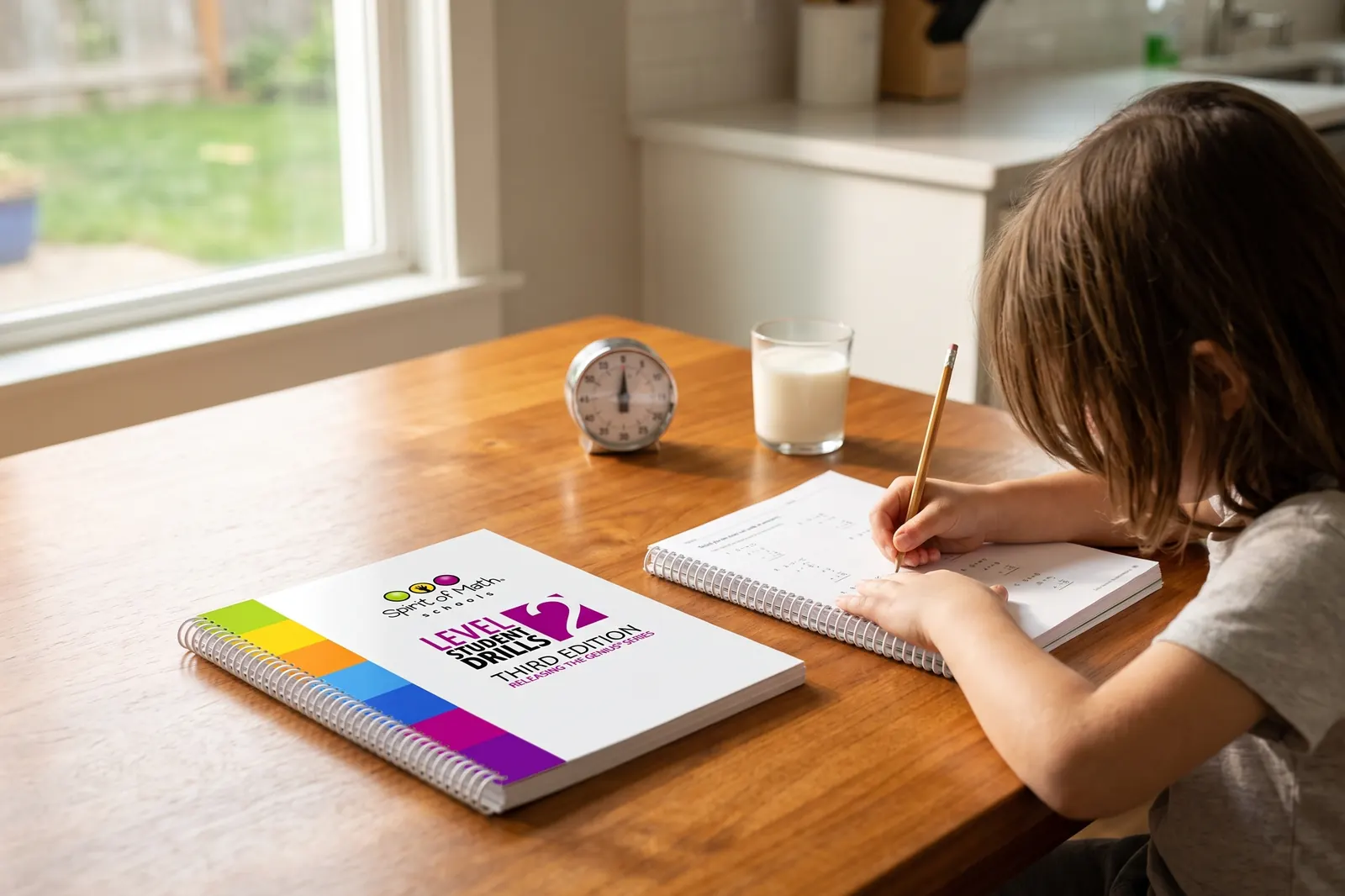
The grid drills from the Spirit of Math classroom, in a spiral-bound workbook with a whole school year of drills at one level. Fill the grid column by column against the clock, mark it, plot the score — and watch number facts become automatic.
- Levels 1–6, one per grade
- A full school year of drills
- Answer book required · in the bundle
- Prices in CAD · Shopify checkout
Canada's contest day is February 26, 2027 — 17 weeks away. That is about 85 school days of drills between now and then.
 Level 3
One grid. One operation. Five minutes.
This is the format in every Drills book. The numbers down the side and across the top come from the answer book; the clock starts the moment the last one is written. You work down the first column, then the next. Scoring stops at the first blank, so nothing is skipped, and only the wrong answers are circled. Forty questions, five minutes, goal 35.
Short Multiplication · 8 × 5 grid
| × | 5 | 7 | 3 | 2 | 9 |
|---|---|---|---|---|---|
| 85 | |||||
| 12 | |||||
| 49 | |||||
| 76 | |||||
| 33 | |||||
| 60 | |||||
| 97 | |||||
| 24 |
The side and top numbers are already written — in the real book they come from the answer book. Press start and the clock runs. Type an answer and the pencil moves to the next cell down the column.
Six steps, the same every day. That's the system.
The drills were built for a fast pace, a specific and quantifiable goal, and drills that are fun, not tedious. The routine is printed in every book; do it the book's way and the scores climb.
Generate the index column
The warm-up. Add 3 to the top number and keep going down the side of the grid — the bottom number checks your work.Write the index row
The numbers across the top come from the answer book. Writing them down is the last thing before the clock.Timing starts
Start at the top of the first column and finish it before the next. Never skip a number.Pencils down
A fixed time for every drill — five minutes for the short calculation drills at this level. Finish early? Note the time.Mark it
Circle only the wrong answers. The score is out of every question on the grid, counted up to the first blank.Plot the score
Each section has a progress graph: score on one line, time on the other. Reach the goal three times in a row and move on.
The drills a Grade 3 student does.
| Drill type | Time | Goal |
|---|---|---|
| Regroupingto 50 and to 100 | 60 seconds | 8 of 10 |
| Skip countingby 2s, 5s and 25s | 1–2 minutes | 17 of 20 |
| Super Speed Addition1-digit, 8 × 5 grid | 3 minutes | 13 of 15 |
| Short Addition40 questions | 5 minutes | 35 of 40 |
| Integer Addition40 questions | 5 minutes | 35 of 40 |
| Short Multiplication40 questions | 5 minutes | 35 of 40 |
| Short Division40 questions | 5 minutes | 35 of 40 |
| Long Multiplication | 5 minutes | 7 of 9 |
Times and goals as printed in the books. Most drill types come at several difficulty levels inside a book, and the challenge rises as more digits are used.
Level matches grade. Not sure between two? Start lower: the goal is automatic recall at speed, and a drill a child can already do is the one they beat tomorrow.
Six things that happen to a child who does these drills.
- Develop a form of numeracy that goes beyond just the number facts they learn
- Improve their estimation skills
- Improve their ability to focus
- Become more confident and accurate in numerical calculations, enabling them to concentrate on concepts and to learn new material more effectively
- Increase their self-confidence, and learn to focus on self-improvement — some parents notice a marked reduction in their child's "math-phobia"
- Solve problems more easily because they are able to concentrate on the concept being explored, rather than being stuck on the numbers in the problem
From the Note to Parents printed in every Drills workbook, by Kimberley Langen, Co-Founder of Spirit of Math Schools.
Choose your set
Prices in CAD. Shipping and taxes are calculated at Shopify checkout, before you pay. Already have the workbook? Buy the Teacher Solution Book on its own.
Before you buy
Do I really need the Teacher Solution Book?
Yes. The drills in the student book cannot be done without it: the answer book carries the index numbers (the anchor numbers) each drill is built on, as well as the answers for marking. The books are sold separately because one answer book serves a whole class — or every child in a family at that level. The bundle is the workbook and the answer book together, at a saving.
Which level should I choose?
Level matches grade: Level 3 is the Grade 3 book. The drill types in each level are listed above. If your child finds their grade's arithmetic slow or effortful, start one level down — the point is speed and automaticity, and a page a child can't finish teaches less than one they beat.
How long does a drill take?
It depends on the type: 20 to 60 seconds for regrouping, one to two minutes for skip counting, three minutes for Super Speed Addition, five minutes for the 40-question short calculation drills and ten for the 80-question ones at Level 6. Add a minute to mark and plot it. The timings are fixed on purpose — the same time, drill after drill, is what lets you see progress.
When do we move to the next drill?
At home, the book says: once your child reaches the goal printed on the drill three times in a row (a perfect score three times, without using the tables at the back, is the other sign). In a class, the whole group should average more than 85% first.
What if my child doesn't finish in time?
Most children don't when a drill type is new. Mark up to where they stopped, record the score on the progress graph, and go again tomorrow — the graph is the point. If they finish early, note the time on the graph's second line and try to beat it.
My child is left-handed.
The grids have a "lefty" index column on the right-hand side, and the index row can be written right to left, so a left hand never covers the numbers it needs.
Is this the contest?
No. The shop never sells contest registration — schools register on the registration platform. Drills build the fast, sure arithmetic contest questions assume; past papers are free to download.
Can my school order a class set?
Yes — one answer book per classroom, a workbook per student. Request a quote and the order can ride your school's existing invoice, no personal card needed.
Where does it ship from, and how much is shipping?
Orders ship from Canada; the rate and delivery estimate are shown at Shopify checkout, before you pay. International orders may be charged duties on arrival.
The 2027 contest season is coming.
Registration opens September 15, 2026. Workbooks and class gear ship ahead of each country's contest day — schools can order on invoice.