
100 problems a year. The kind school doesn't ask.
Math Problem of the Day gives high-performing students their first exposure to mathematics topics not normally seen in schools: 100 problems a book, organised by type, each type opening with a worked example. The same problems the Spirit of Math after-school program is built on — for the kitchen table or the classroom.
- Levels 1–6 · 100 problems each
- A worked example opens every section
- Final answers in the book · full solutions in the bundle
- Prices in CAD · Shopify checkout
Canada's contest day is February 26, 2027 — 17 weeks away. One problem a school day is about 85 problems before contest day — a book is 100.
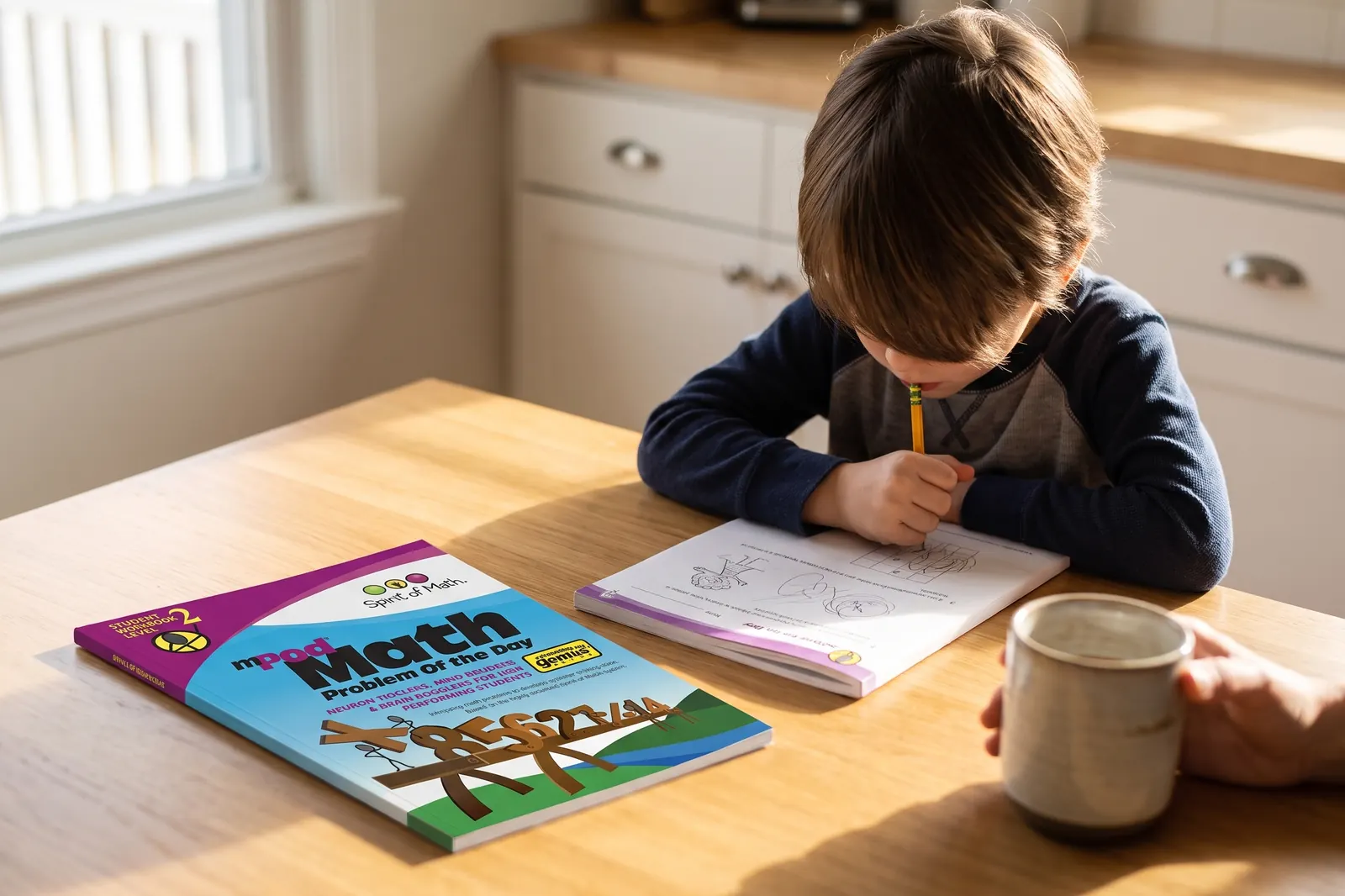 Level 3
A worked example first. Then problems of the same kind.
Every section in the book opens with a Super Starter — a sample solution to lean on if the child gets stuck — followed by five, or a multiple of five, problems of that type: a week of one a day. Here is one section, in the Level 3 style: read the starter, then try the problem.
A bookcase has 3 shelves. The top shelf holds 4 books and each shelf below holds 2 more than the one above. How many books are on the bottom shelf?
- Top: 4. Middle: 4 + 2 = 6. Bottom: 6 + 2 = 8.
- The bottom shelf holds 8 books.
A bookcase has 4 shelves. The top shelf holds 5 books, and each shelf below holds 6 more books than the shelf above it. How many books are on the bottom shelf?
9 problem types. 100 problems.
- Age Problems
- Awesome/Astounding Averages
- Before and After
- Consecutive Numbers
- Divisibility Rules
- Handshake Questions
- Heads and Legs
- Muddle of Mind Treasures
- Venn Diagrams
The section names as listed in the books' topics table. The problems work up in complexity within each book and from one book to the next; the series covers 35 problem types across the six levels.
Which level? Each book is written for a Spirit of Math student in the same grade as its level. The books say the levels may be too difficult for a child who hasn't met this kind of thinking before — for them, Level 3 suits Grades 3 to 6.
| Level | Spirit of Math student | New to this thinking |
|---|---|---|
| Level 1 | Grade 1 | Grades 1–3 |
| Level 2 | Grade 2 | Grades 2–4 |
| Level 3 | Grade 3 | Grades 3–6 |
| Level 4 | Grade 4 | Grades 4–7 |
| Level 5 | Grade 5 | Grades 5–8 |
| Level 6 | Grade 6 | Grades 6–9 |
One type at a time, start to finish.
Work through the book in order, or pick a type. Either way the book asks you to start one type, finish it, then move to another — so a way of thinking has a week or two to settle.
The Super Starter
The first page of most sections has sample solutions: a method to use as a foundation if the child gets stuck, or a class example.Five of a kind
Each section holds five, or a multiple of five, problems of one type — one a day fits a week of classes, and the type gets consolidated.Check, then go deeper
Final answers are at the back of the workbook (tear the page out if you'd rather the child not see them). The Solution Book has the full solution and what each type is building.Home-grown problems
Each section ends with the child writing their own problems of that type — creators, not just recipients, of questions.
The child who has found the thrill of math.
The books are written for the Spirit of Math student: a high-performing child who is focused, thrives on challenges, and isn't frightened to do whatever it takes to get the work done. The problems are meant to be fun and, at the same time, to challenge how a child thinks.
“At a truly fundamental level, Spirit of Math started me off in the sort of frame of mind that I keep and carry with me today.”
Three of the book's secrets to strong problem-solvers
- Let the kids figure out a lot themselves and be creative, within the confounds of the rules of mathematics.
- Don't be afraid to challenge kids! Develop a deep understanding of mathematical concepts — don't just skim the surface.
- Give a variety of questions covering topics you haven't necessarily touched on. This is the key to developing kids who won't be frightened to try new things.
From “Some Secrets to Developing Strong Problem-Solvers” in the mPOD workbooks, by Kim Langen, author and Co-Founder of Spirit of Math.
Choose your set
Prices in CAD. Shipping and taxes are calculated at Shopify checkout, before you pay.
Before you buy
Which level should I choose?
Each book is written for a Spirit of Math student in the same grade as its level. For a child who hasn't met this kind of thinking before, the books themselves suggest a wider range: Level 3 for Grades 3 to 6. If in doubt, start lower — the point is the thinking, and a problem the child can get into teaches more than one they can't start.
Do I need the Solution Manual?
The workbook has the final answers at the back, so a child can check themselves. The Solution Manual is for the adult: the full solution to every problem, and what each type is building for the higher grades — so you can help without giving the answer away. It comes in the bundle; buy the workbook alone for a second child at the same level.
How many problems, and how long do they take?
100 problems a book, in sections of five or a multiple of five of one type. One a day is the rhythm the books are built around, so a section is a week or two and a book is a school year. A problem is meant to take real thinking, not a set number of minutes.
Are these the problems from Spirit of Math classes?
They are similar to the problems taught in the Spirit of Math after-school program, which is more intensive and covers much more than these books. mPOD is the series' introduction to that kind of problem.
How is this different from Drills?
Drills make number facts fast and automatic — a timed grid a day. mPOD is the opposite kind of page: one problem that takes real thinking. Many families run both: the drill first, then the problem.
Is this the contest?
No. The shop never sells contest registration — schools register on the registration platform. mPOD problems are in the spirit of contest questions; the real past papers are free to download.
Can my school or class use these?
Yes — the books were written for classrooms as much as homes: a Super Starter as the class example, groups of four for discussion, one Solution Manual for the teacher. Request a quote and the order can ride your school's existing invoice.
Where does it ship from, and how much is shipping?
Orders ship from Canada; the rate and delivery estimate are shown at Shopify checkout, before you pay. International orders may be charged duties on arrival.
The 2027 contest season is coming.
Registration opens September 15, 2026. Workbooks and class gear ship ahead of each country's contest day — schools can order on invoice.